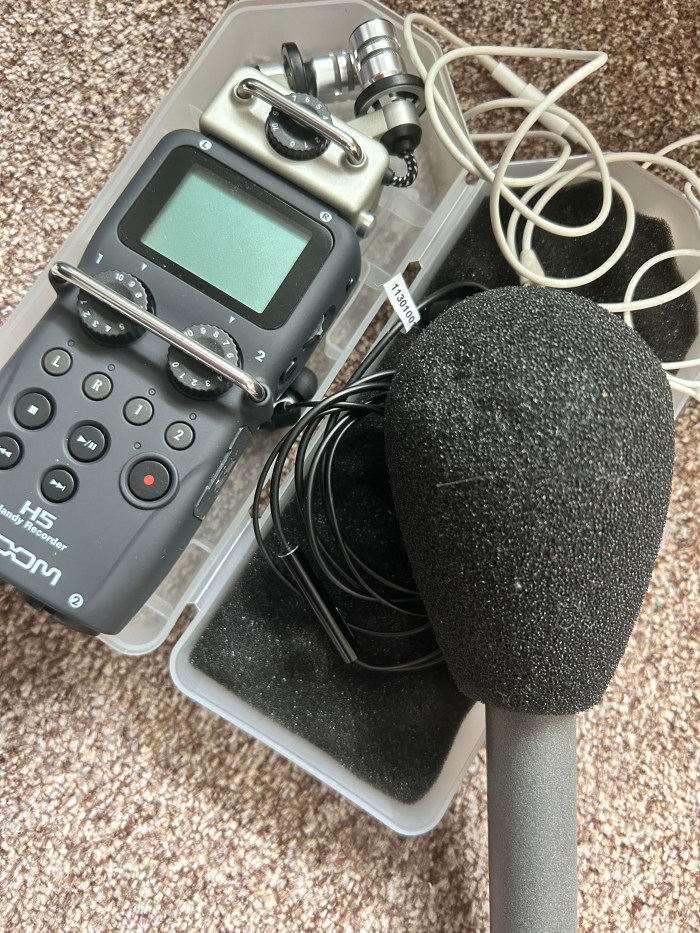
This week I sat down with a local journalist in my hometown of Southport, and asked him about his life and career.
Was this a drink-fuelled reunion?
No.
It was the start of an oral history project I have been working towards for a year, to preserve the experiences of the people who produced local newspapers.
An industry that was once a part of every home in the UK is disappearing. While some may have only used the local newspaper to line the cat litter tray, those of us over the age of 30 remember when free papers full of local news came through the door every week, while alternatives were available to buy in every town.
A year or so ago I began to think we should be capturing the memories of those who worked in this industry. But the more research I did, the more I also realised how vital local news is. While newspapers as a product feel like an anachronism, the need for local news for local people is as important as it ever was.
I began my career on a local freesheet, as they were called. But even we had a newsroom of eight, and regularly produced newspapers with up to 50 pages of news and advertising.
Now the situation is very different.
Since 2005, at least 293 local newspapers have closed, around a third of the sector. The number of journalists employed by the three largest local news publishers (which now account for around 60% of the local news publishing market) fell from circa 9000 to circa 3000 between 2007 to 2022. It’s been said that Britain now has fewer local papers than at any time since the 18th century. But there is also a worrying impact on readers. Research shows that people who follow local news are more likely to participate in political processes and engage in their local community.
Newspapers as a product are considered hopelessly out of fashion. The advent of the internet, with its unlimited ‘free’ column space and advertising potential, has almost destroyed the business model for the local newspaper. Meanwhile, now anyone can ‘publish’ whatever they like, words or photographs, everyone thinks they can be a journalist and fewer and fewer are prepared to pay for professionally produced news.
Why have I put ‘free’ in inverted commas? After all, we don’t have to pay for our social media accounts.
But what many still don’t realise is they are ‘paying’.
Their personal information and likes and dislikes are hoovered up by their accounts, and used to influence the advertising they see, and the posts they’re offered to view, making huge amounts of money for the companies that run their accounts, and often for the people posting material they agree (or disagree) with. Which means we can end up in an endless loop of content that isn’t balanced (or even verified in some cases) and so never challenges any of our beliefs.
Social media accounts are also predominantly about communicating with the individual, while newspapers were shared in pubs, cafes and homes, the leader column a voice for the local community, championing causes to central government, and representing the community back to itself.
And even those local newspapers that still exist are struggling. Relentless budget and job cuts have meant a hollowing out of their expertise and contacts, leaving many publishing PR led content and celebrity gossip.
Now we’re starting to realise that communities without a thriving newspaper face a vacuum, and in many communities that can so easily be filled with hatred and misinformation.
That came home to me in Southport, where I now live, during the terrible events of 2024. Three young girls were stabbed and killed, and others, including adults, seriously injured, during a senseless attack on a children’s holiday club. In the hours after it happened, inaccurate information about the attacker went viral online, sparking riots in the town and subsequently across the country.
Southport has been served by many local titles, but its main newspaper, The Southport Visiter, is one of the oldest local papers in the UK. An edition is still published each week, but it has been merged with the Liverpool Echo and has no separate website, or office or dedicated journalists based in Southport. Liverpool is, at best, an hour’s journey away.
The crisis in local news has generated campaigns from the National Union of Journalists and government inquiries – resulting in the launch of a Local Media Action plan in Spring 2026. This includes a £6 million local news fund, increasing Community Radio funding to £1 million per year, championing local media as a high-quality channel for advertising and supporting smaller publishers to measure audiences. And there is some positive news when it comes to local news provision. Between September 2020 and July 2022, 41 new local digital news outlets were launched with only three closing. Digital subscriber-led products such as The Manchester Mill and Liverpool Post, and The Southport Lead, are thriving – and winning awards for their journalism.
In 2025, I teamed up with two other journalist /academics – Dr Rachel Matthews based in the Midlands and Clare Jenkins from Sheffield. Clare has already recorded around 25 oral history interviews with journalists across Sheffield, while Rachel has been working on newspaper archives in several areas. We want to preserve the experiences of those who have lived through this seismic change in local news provision, but also gather evidence to support why local news is still so very important. We’re part of the Oral History Society and we’ve set up a Journalism Special Interest Group.
We hope to broaden the project to cover the whole of the UK eventually, but, at the moment, I am starting a pilot project in Southport, to record with those who helped produce the local newspapers The Visiter and The Champion. And this week, I began my first interview with Jamie Lopez of The Southport Lead.
The recordings will ultimately be deposited in the British Library’s oral history archive. But there will be chances to hear some of the recordings and find out more, during talks I’ll be giving this year at The Atkinson arts centre in Southport and as part of the Heritage Open Days Festival – so watch this space for more updates!